Reference
Crochet hook sizes, converted and explained
A pattern might call for a 4.0 mm hook, a G-6, or an old UK 8 — and all three can mean the same tool. This is the conversion, the yarn each size usually suits, and why the hook a pattern names is a starting point rather than an instruction.
Conversion chart
Millimetres are the real measurement — the diameter of the shaft, which is what decides the size of your stitches. Everything else is a naming convention.
| Metric | US | Old UK | Usual yarn | Typically used for |
|---|---|---|---|---|
| 2.25 mm | B-1 | 13 | Super Fine | Socks and fine thread-weight work. |
| 2.75 mm | C-2 | — | Super Fine | Fingering yarn; tight amigurumi in fine yarn. |
| 3.125 mm | D | — | Super Fine, Fine | An in-between size; the Council lists D against both this and 3.25 mm. |
| 3.25 mm | D-3 | 10 | Super Fine, Fine | Sport-weight yarn and dense small toys. |
| 3.50 mm | E-4 | — | Fine | Baby yarns, lightweight accessories. |
| 3.75 mm | F-5 | 9 | Fine, Light | A common amigurumi choice with DK yarn — tight enough to hide stuffing. |
| 4.00 mm | G-6 | 8 | Light | DK garments and blankets. |
| 4.25 mm | G | — | Light | Also sold as G, which is why a letter alone is not enough to match a pattern. |
| 4.50 mm | 7 | 7 | Light, Medium | Between DK and worsted; useful when your gauge runs tight. |
| 5.00 mm | H-8 | 6 | Medium | Worsted yarn; a common general-purpose size. |
| 5.50 mm | I-9 | 5 | Medium | Worsted with more drape; wearables. |
| 6.00 mm | J-10 | 4 | Medium, Bulky | Heavy worsted and light bulky; fast blankets. |
| 6.50 mm | K-10½ | 3 | Bulky | Bulky yarn, bags and baskets. |
| 7.00 mm | — | 2 | Bulky | Bulky yarn. The Council's chart lists no US letter for this size. |
| 8.00 mm | L-11 | 0 | Bulky | Chunky yarn; open, drapey fabric. |
| 9.00 mm | M/N-13 | 00 | Super Bulky | Super bulky yarn and quick throws. |
| 10.00 mm | N/P-15 | 000 | Super Bulky | Super bulky; loose, airy fabric. |
| 15.00 mm | P/Q | — | Jumbo | Jumbo yarn, arm-knitting-scale work. |
| 16.00 mm | Q | — | Jumbo | Jumbo yarn. |
| 19.00 mm | S | — | Jumbo | Jumbo yarn and rope; very open fabric. |
- Millimetre and US sizes are checked against the Craft Yarn Council's hook and needle chart. US letters vary between manufacturers — the Council itself lists G against both 4.0 mm and 4.25 mm — so the millimetres on the packaging are the measurement to trust.
- The old UK numbers are not part of that standard; the Craft Yarn Council publishes no UK column. They are cross-checked across published conversion charts and left blank where those charts disagree, which happens at 2.75 mm and 3.5 mm because the old UK system was built around 2.5, 3.0 and 7.0 mm rather than the modern metric set.
- This chart covers the sizes commonly sold for yarn. The Council's full chart also lists 2.5, 5.25, 5.75, 11.5, 12, 15.75, 25 and 30 mm, and steel hooks for thread work use a separate scale of their own that runs from about 3.5 mm down to 0.6 mm.
Why the same hook has three names
Metric sizing measures the shaft and is used by most modern patterns worldwide. US sizing uses letters and numbers that run upward with size, but the mapping has never been perfectly consistent between manufacturers — the Craft Yarn Council’s own chart lists G against both 4.0 mm and 4.25 mm, which is a real difference in a garment.
The old UK numbers run the opposite way: the larger the number, the smaller the hook. You will still meet them in vintage patterns and in inherited hook rolls, which is why they are in the table above — but they were never standardised alongside the metric sizes, and published charts disagree about which modern size inherits which old number. Where they disagree, the table leaves the cell blank rather than picking one. Steel hooks for thread work have their own numbering that also runs backwards, and it is separate again from the UK system.
When a pattern and a hook disagree, trust the millimetres.
Choosing a hook for your yarn
Yarn labels print a recommended hook size, and it is a reasonable default — but what you are making matters more than the label.
For a blanket or a scarf you usually want the recommended size or a little larger, because drape is the point and a loose fabric falls better. For amigurumi you almost always want to go smaller — often one or two sizes below the label — because stuffing will show through any gap between stitches. A 3.5 mm or 3.75 mm hook with DK yarn is a common amigurumi pairing for exactly this reason.
Full yarn thicknesses, the names they go by and the hook ranges that suit them are in the yarn weight guide.
The parts of a hook
- Head
- The tip that goes into the stitch. Rounder heads push through more easily; pointier heads split yarn less.
- Throat
- The hooked part that catches the yarn. A deeper throat holds a loop more securely.
- Shaft
- The straight section whose diameter is the hook's real size — this is what makes your stitches their size.
- Thumb rest
- The flattened part where most people pivot the hook. Its position decides how the hook sits in your hand.
- Handle
- The remainder of the grip. Thicker handles reduce strain over long sessions for some hands.
Two hooks of the same size can still feel different: an inline head sits flush with the shaft and makes tighter, more even stitches, while a tapered head slides into stitches more easily. Neither is correct — it is worth trying both before buying a set.
When to change hook size
Patterns that matter dimensionally — garments, bags, anything that has to fit — give a gauge: a number of stitches and rows over a measured square. Work that square first. If you have more stitches than the pattern says, your tension is tight and a larger hook will fix it; fewer stitches means a smaller hook. Changing hook size is the normal remedy, not a sign you are doing something wrong.
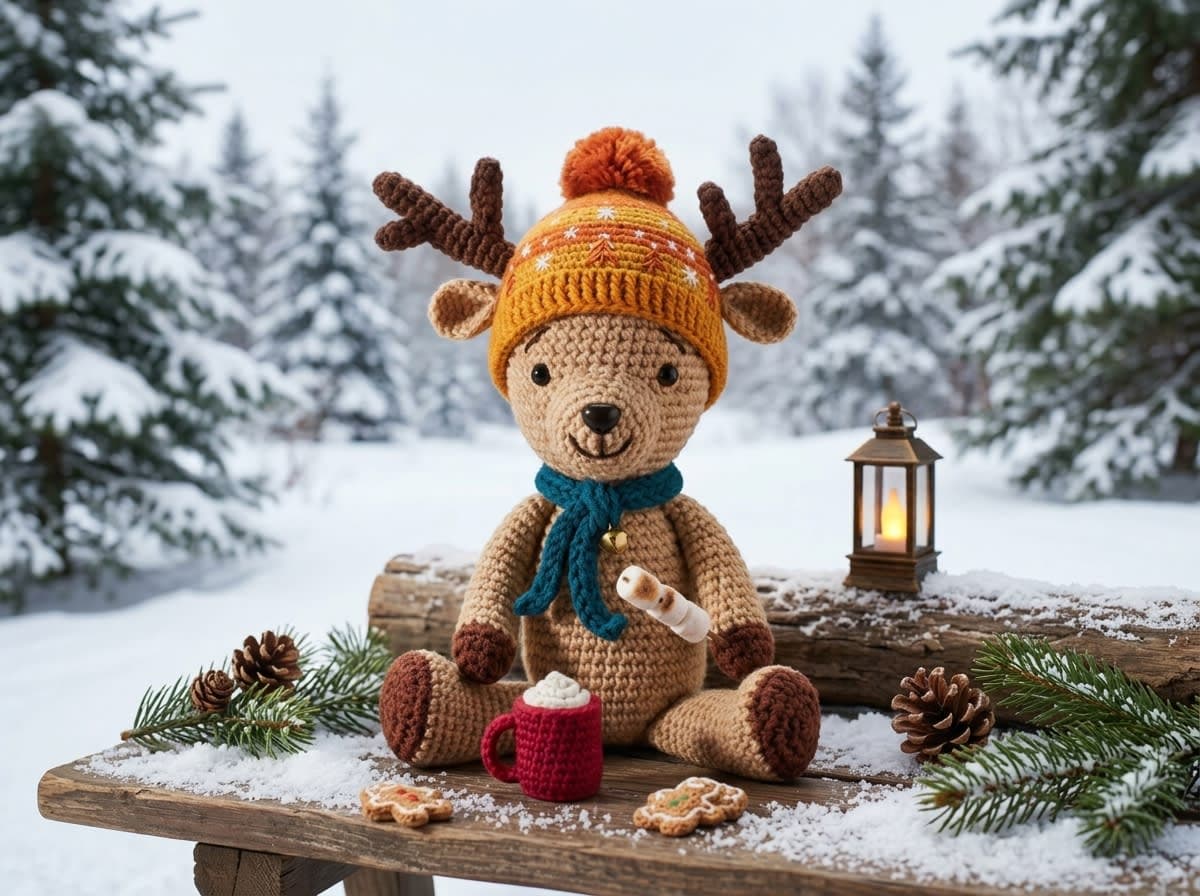
For toys, gauge matters less in absolute terms — a slightly larger reindeer is still a reindeer — but a fabric loose enough to show stuffing is worth re-hooking for.
Patterns from the shop
Each pattern names the hook size it was worked with, and the yarn it was designed for.